Raw Recruit
Commodore 64 - Raw Recruit
Oxford Road, Manchester — and the people who worked there
Software Creations was a Manchester studio, and for a stretch of the late eighties and early nineties it was one of the best places in the country to be if you wrote games. Richard Kay set it up in 1985 and got it going properly the year after, off the back of an advert in the Manchester Evening News. The office was on Oxford Road, above a computer shop directly opposite the BBC.
The early work was conversions, often for Firebird, and often for a few hundred pounds a game. What the company got a name for was taking arcade machines and putting them on home hardware that had no business running them. Bubble Bobble on the Commodore 64 is the one people still bring up. Bionic Commando was another. The trick was never really the graphics, it was deciding what to throw away and getting the feel of the thing to survive the journey.
I came to it after Binary Design, and the C64 work I did there is elsewhere on this site. The one that people ask about is Gauntlet III, which was finished and reviewed and then never properly released, for reasons that had nothing to do with the code.
Small companies are just the people in them. These are the ones whose work is on the record, and what they did with it.
Software Creations was his. He set it up in 1985 and got it properly moving in 1986, after an advert he placed in the Manchester Evening News was answered by Steve Ruddy. The office was on Oxford Road, above a computer shop directly opposite the BBC.
What he built there was a studio with a reputation for taking on the arcade conversions other people said could not be done on the hardware, and then doing them. Bubble Bobble on the Commodore 64 is the one everybody remembers. He has told the story himself in a good many interviews since, and it is worth hearing from him.
Came to the company from Ocean, where he had been a programmer, and helped get Software Creations off the ground in its earliest days.
The one who answered the advert. With Richard Kay, Mike Ager and Andrew Threlfall he made up the first four people at the company.
His name deserves to be better known than it is. He wrote the music drivers that the Follins’ NES work ran on — the code underneath some of the most admired music ever written for the machine. The tunes get the credit, and rightly, but somebody had to build the thing that played them.
Started writing game music on the Spectrum at fifteen, in 1985, and joined Software Creations full time in 1987. From there he wrote across the Spectrum, the C64, the Amiga, the ST and the NES.
The Solstice title theme is the one he has named as his own favourite, and the Silver Surfer score on the NES is still held up as some of the finest music anyone got out of 8-bit hardware. Plok!, Equinox and Rock’n Roll Racing followed in 1993. Thirty-odd years on, people still take those tunes apart to work out how he did it.
Tim’s brother, and his co-writer on a great many of the NES soundtracks that came out of the company. The pair of them wrote either together or in turn across most of what Software Creations shipped, and he wrote the music for Puzznic on the C64.
The third of the Follin brothers at the company, on the programming side rather than the music.
Drew for Gauntlet III alongside Martin Holland, and had come through Binary Design before that, so our paths ran along much the same track.
He went a long way afterwards: lead designer on Darksiders and Darksiders II, and creative director roles in the United States since. A good artist who turned into a good designer, which is rarer than it sounds.
Worked on the Gauntlet III graphics with Haydn Dalton. He is also the reason the story of that game is on the record at all — he was the one who told Games That Weren’t what had happened to it.
Hired at the very start, alongside Richard Kay and Steve Ruddy, when the whole company would fit in one room above a shop.
Came in as the company grew past its first handful of people, working on the art side.
The company was sold to Bristol Coin Equipment, later Rage Software, in 1994, and again to Sweeplink in 1997. Acclaim bought it in 2002 and renamed it Acclaim Studios Manchester, and that closed in 2004. Former staff started SilverBack Studios the following year. By then the catalogue behind it ran from Bubble Bobble on the C64 through Solstice and Plok! on the Nintendo machines to Mortal Kombat 3.
The move after games was to Barcrest, in Ashton-under-Lyne — the country’s biggest name in fruit machines, and fourteen years and nine months of gaming machines, safety and emissions testing, and writing reel and video games in Forth, C and C++.
That has a page of its own now: Barcrest, and fourteen years of gaming machines — the jobs, what the work actually involved, and what became of the company.
Dates, credits and company history here are drawn from the public record — Wikipedia, Games That Weren’t, and interviews Richard Kay has given about the company since. If I have any of it wrong, or missed somebody who should be here, tell me and I will put it right.
Strike! – 1987
A bowling game published by MAD / Mastertronic. Players compete in a
ten-pin bowling tournament, aiming for strikes and spares while mastering the timing and
accuracy needed to send the ball down the lane.
Raw Recruit – 1988
A multi-event sports game in which players take control of a new
army recruit undergoing military training. Events include obstacle courses, shooting practice
and fitness challenges, all designed to test speed and skill.
Scumball – 1988
A quirky multi-screen platform game where the player controls a
bouncing ball-like character through a series of dangerous rooms filled with enemies, ladders
and traps. The goal is to collect items and survive long enough to reach the next stage.
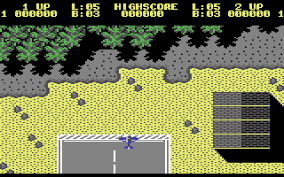
Sky Shark (US Version) – 1988
A vertically scrolling shoot-'em-up based on the arcade
game by Taito. Players pilot a fighter plane through enemy territory, avoiding heavy fire while
destroying tanks, ships and aircraft across increasingly difficult levels.
War Cars Construction Kit – 1988
Part action game and part creation tool, this title
allows players to design their own arenas and then battle computer-controlled opponents using
armed vehicles. It offered a surprising amount of freedom for a Commodore 64 game of the era.
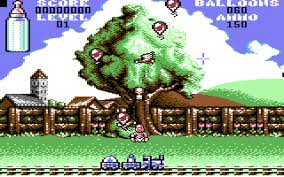
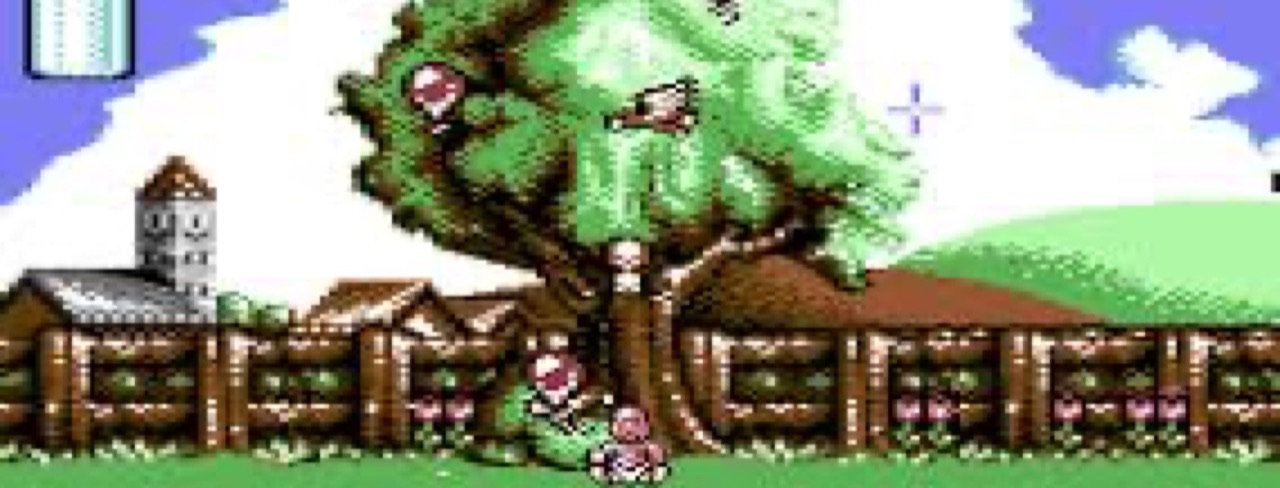
Baby Blues – 1990
A fast-paced crosshair shooter in which the player must defend
against waves of cartoon-style enemies. The game combines quick reflexes with colourful graphics
and a light-hearted sense of humour.
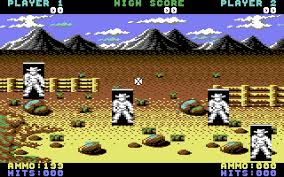
Gunslinger – 1990
A Wild West themed shooting game where the player takes on the role
of a lone gunslinger facing enemies in a series of quick-draw shootouts. Success depends on fast
reactions and accurate aim.
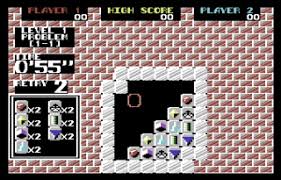
Puzznic – 1990
A conversion of the popular arcade puzzle game. Players must slide
matching blocks together to make them disappear, solving increasingly complex puzzles using
logic and careful planning.
Gauntlet III: The Final Quest – 1991
An action game inspired by the Gauntlet series,
featuring dungeon exploration, monsters and treasure. Players guide their hero through maze-like
levels, battling enemies and searching for the exit while collecting power-ups along the way.
:contentReference[oaicite:7]{index=7}