Raw Recruit
Commodore 64 - Raw Recruit
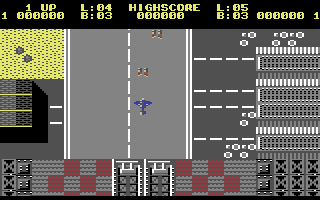

Commodore 64.
Baby Blues on the Commodore 64 is one of those lesser-known titles associated with the era of small-scale and budget-driven game development. Developed by Martin Howarth, it sits within a broader catalogue of work that reflects the creativity and constraints of late C64 software production. Like many games of its time, it was built around simple mechanics, immediate playability, and an emphasis on gameplay loops rather than complex narrative structure.
The Commodore 64 scene in the late 1980s and early 1990s was filled with experimentation, where individual programmers and small teams often produced highly original concepts within tight technical limits. Baby Blues fits into this environment as a product of focused design thinking: taking a straightforward idea and shaping it into something playable and engaging on limited hardware. Developers like Martin Howarth often had to balance performance, memory usage, and visual clarity, which heavily influenced the final feel of their games.
In terms of presentation, Baby Blues follows the general visual style common to many C64 releases of the period. Sprites are typically bold and functional, designed to be readable against busy or colourful backgrounds. The Commodore 64’s palette, while limited, was often used creatively to give each screen a distinct atmosphere. Games like this tended to rely more on strong contrast and animation clarity than detailed artwork, ensuring the player could quickly understand what was happening on screen.
Gameplay on titles from this era and development context usually focuses on direct control and repeatable challenge structures. Rather than relying on long tutorials or complex systems, the player is placed directly into the action. The learning curve is typically short but mastery takes time, with increasing difficulty coming from faster pacing, tighter timing requirements, or more complex arrangements of obstacles and enemies. This design philosophy made games highly replayable, even if they were simple by modern standards.
Audio on the Commodore 64 also played an important role in shaping the identity of games like Baby Blues. Even minimal sound effects could add tension or feedback, while a memorable SID tune could elevate the entire experience. Many C64 games of the period are still remembered as much for their music as for their gameplay, and sound design was often used to compensate for graphical limitations. Whether simple or more ambitious, audio was an essential part of the overall presentation.
From a historical perspective, Baby Blues represents a snapshot of a transitional period in home computer gaming. It reflects the tail end of the Commodore 64’s commercial life, when developers were highly experienced with the hardware and able to extract impressive results from it despite its age. While it may not have achieved widespread recognition compared to major commercial hits, it remains part of the broader creative output that defined the machine’s library and the careers of its developers.
Today, games like Baby Blues are often appreciated by enthusiasts who explore the full depth of the C64 catalogue. They provide insight into the working methods of programmers like Martin Howarth and illustrate how much variety existed even outside the best-known releases. In that sense, Baby Blues stands as a small but meaningful piece of Commodore 64 history, representative of an era when even modest games were crafted with ingenuity and determination.
Strike! – 1987
A bowling game published by MAD / Mastertronic. Players compete in a
ten-pin bowling tournament, aiming for strikes and spares while mastering the timing and
accuracy needed to send the ball down the lane.
Raw Recruit – 1988
A multi-event sports game in which players take control of a new
army recruit undergoing military training. Events include obstacle courses, shooting practice
and fitness challenges, all designed to test speed and skill.
Scumball – 1988
A quirky multi-screen platform game where the player controls a
bouncing ball-like character through a series of dangerous rooms filled with enemies, ladders
and traps. The goal is to collect items and survive long enough to reach the next stage.
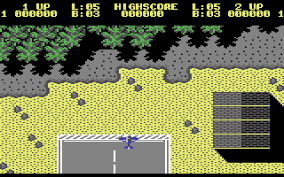
Sky Shark (US Version) – 1988
A vertically scrolling shoot-'em-up based on the arcade
game by Taito. Players pilot a fighter plane through enemy territory, avoiding heavy fire while
destroying tanks, ships and aircraft across increasingly difficult levels.
War Cars Construction Kit – 1988
Part action game and part creation tool, this title
allows players to design their own arenas and then battle computer-controlled opponents using
armed vehicles. It offered a surprising amount of freedom for a Commodore 64 game of the era.
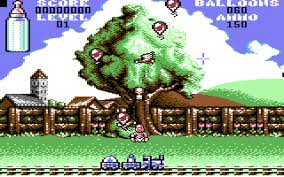
Baby Blues – 1990
A fast-paced crosshair shooter in which the player must defend
against waves of cartoon-style enemies. The game combines quick reflexes with colourful graphics
and a light-hearted sense of humour.
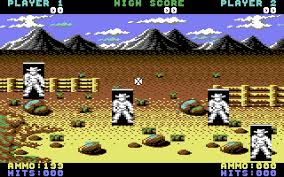
Gunslinger – 1990
A Wild West themed shooting game where the player takes on the role
of a lone gunslinger facing enemies in a series of quick-draw shootouts. Success depends on fast
reactions and accurate aim.
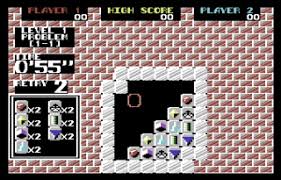
Puzznic – 1990
A conversion of the popular arcade puzzle game. Players must slide
matching blocks together to make them disappear, solving increasingly complex puzzles using
logic and careful planning.
Gauntlet III: The Final Quest – 1991
An action game inspired by the Gauntlet series,
featuring dungeon exploration, monsters and treasure. Players guide their hero through maze-like
levels, battling enemies and searching for the exit while collecting power-ups along the way.
:contentReference[oaicite:7]{index=7}