Raw Recruit
Commodore 64 - Raw Recruit
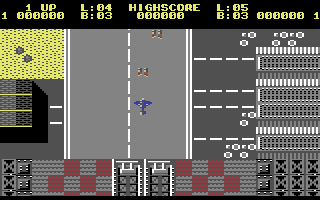
Commodore 64.
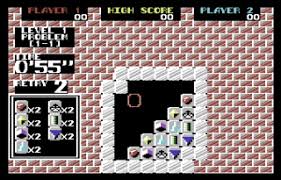
Puzznic is one of the finest puzzle games to appear on the Commodore 64. Released in 1990 by Ocean and developed by Software Creations, it was based on the popular arcade game from Taito. At a time when puzzle games such as Columns and Klax were becoming increasingly popular, Puzznic stood out because it relied less on speed and more on careful planning. The result was a game that was simple to understand but surprisingly difficult to master.
The basic idea of the game is very straightforward. Each level is filled with coloured blocks, and the player must remove every block from the screen. To do this, two matching blocks have to be moved so that they touch each other. When they meet, they disappear, causing any blocks above them to fall. The challenge comes from the fact that the player can only move blocks left and right, while gravity constantly affects everything on the screen. A single mistake can leave one block stranded, making the level impossible to complete.
Although the early levels seem easy, the difficulty rises very quickly. Later puzzles introduce moving platforms, narrow ledges and awkward arrangements that require careful thought several moves in advance. Often the solution is not obvious, and players may spend several minutes staring at the screen before making a move. Puzznic becomes less about reflexes and more about logic, which is one of the reasons why it is so addictive. There is always the feeling that the next puzzle can be solved if you think about it for a little longer.
The Commodore 64 version contains 144 levels, fewer than some other versions of the game, but still more than enough to provide a serious challenge. The puzzles are divided into sections, with four problems in each group. After completing a section, the player can choose where to go next on a map screen, giving the game a little more variety and allowing different routes through the puzzles. Unlike the arcade version, the C64 release also allows unlimited continues and lets players choose from the first twenty-one sections from the start.
Controlling the game is simple. A red cursor is used to select a block, and by holding down the fire button while moving the joystick, the block can be pushed left or right. The controls are easy to learn, although some players find the movement slightly slow and awkward, especially when trying to place blocks onto moving platforms at exactly the right moment. Timing becomes very important in the later levels, and even a tiny error can ruin an otherwise perfect plan.
Graphically, Puzznic is neat and colourful rather than spectacular. The blocks are easy to recognise, and the animation when they disappear looks satisfying. The game does not try to match the arcade version exactly, but it works well on the Commodore 64. The music, written by Geoff Follin, is another highlight. Players can choose either music or sound effects during the game, and the music becomes faster as time begins to run out, increasing the tension.
Many Commodore 64 fans still remember Puzznic fondly because of how addictive it was. Even today, people often describe it as one of those games where you sit down for a few minutes and end up playing for hours. The combination of simple rules, clever level design and steadily increasing difficulty gives the game a timeless quality. For anyone interested in puzzle games on the C64, Puzznic remains one of the best examples of the genre.
Strike! – 1987
A bowling game published by MAD / Mastertronic. Players compete in a
ten-pin bowling tournament, aiming for strikes and spares while mastering the timing and
accuracy needed to send the ball down the lane.
Raw Recruit – 1988
A multi-event sports game in which players take control of a new
army recruit undergoing military training. Events include obstacle courses, shooting practice
and fitness challenges, all designed to test speed and skill.
Scumball – 1988
A quirky multi-screen platform game where the player controls a
bouncing ball-like character through a series of dangerous rooms filled with enemies, ladders
and traps. The goal is to collect items and survive long enough to reach the next stage.
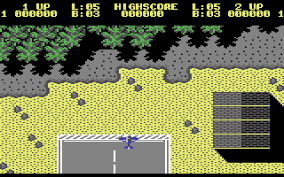
Sky Shark (US Version) – 1988
A vertically scrolling shoot-'em-up based on the arcade
game by Taito. Players pilot a fighter plane through enemy territory, avoiding heavy fire while
destroying tanks, ships and aircraft across increasingly difficult levels.
War Cars Construction Kit – 1988
Part action game and part creation tool, this title
allows players to design their own arenas and then battle computer-controlled opponents using
armed vehicles. It offered a surprising amount of freedom for a Commodore 64 game of the era.
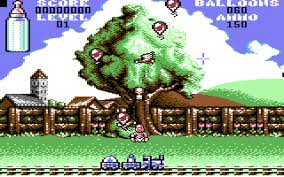
Baby Blues – 1990
A fast-paced crosshair shooter in which the player must defend
against waves of cartoon-style enemies. The game combines quick reflexes with colourful graphics
and a light-hearted sense of humour.
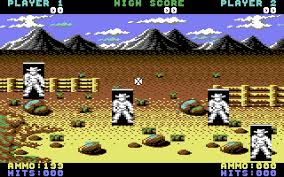
Gunslinger – 1990
A Wild West themed shooting game where the player takes on the role
of a lone gunslinger facing enemies in a series of quick-draw shootouts. Success depends on fast
reactions and accurate aim.
Puzznic – 1990
A conversion of the popular arcade puzzle game. Players must slide
matching blocks together to make them disappear, solving increasingly complex puzzles using
logic and careful planning.
Gauntlet III: The Final Quest – 1991
An action game inspired by the Gauntlet series,
featuring dungeon exploration, monsters and treasure. Players guide their hero through maze-like
levels, battling enemies and searching for the exit while collecting power-ups along the way.
:contentReference[oaicite:7]{index=7}